
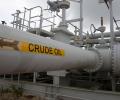
India's procurement of Venezuelan crude oil has picked up momentum since April and the South American nation has already emerged as the third largest oil supplier to the country.

Prime Minister Narendra Modi held talks with Venezuela's acting President Delcy Rodriguez, focusing on strengthening bilateral relations. This marks the first conversation between the leaders since Nicolas Maduro's capture.
MEA spokesperson Randhir Jaiswal said India's energy decisions are guided by national interest.
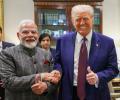
Trump announced that India and the US agreed to a trade deal under which Washington will charge a reduced reciprocal tariff on Delhi, lowering it from 25 per cent to 18 per cent.

'Our diplomacy should have been focused on preventing war and avoiding the inevitable disruptions it would cause, posing a real risk to India's growth story,' asserts former foreign secretary Shyam Saran.

India and the US have agreed to a trade deal that will see Washington reduce reciprocal tariffs on Indian goods from 25% to 18%, according to US President Donald Trump. The deal also includes commitments from India to reduce tariffs and non-tariff barriers against the US and to increase purchases of American products.

United States President Donald Trump reiterated the claims of having to do 'something' about Greenland, saying that if US doesn't take any action, Russia and China would spring in and that Washington, DC does not want to have them as neighbours.

Modi also said that President Trump's leadership is vital for global peace, stability, and prosperity.

In their talks, Modi and Merz are likely to deliberate on trade and investment ties as New Delhi is looking at deepening economic engagement with Europe against the backdrop of Washington's 50 percent tariff on Indian goods, people familiar with the matter said.

'Trump is good news for us. Energy poverty is real, and fossil fuels are the answer.'
'Trump is likely being purposefully vague, hoping that this lack of clarity will pressure India, fearing the worst, to agree to scale back its imports of Russian oil.'
President Trump made these remarks on Monday while talking to reporters aboard Air Force One on his way back to Joint Base Andrews from Florida.
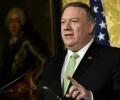
Pompeo will travel to India, Sri Lanka, Japan and South Korea from June 24 to 30. His four-nation is aimed at deepening US partnerships in the strategic Indo-Pacific region.

"As Prime Minister (Narendra) Modi said in his latest campaign, 'Modi hai to mumkin hai,' or 'Modi makes it possible', I'm looking forward to exploring what's possible between our people," Pompeo said in his major India policy speech at the India Ideas Summit of US-India Business Council on Wednesday.
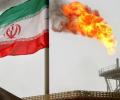
Indian Ambassador to the US Harsh Vardhan Shringla said India has stopped importing oil from Iran after the United States refused to extend exemption from sanctions earlier this month.

So, how does Pompeo's check list look like? In a broad sense, he is coming here 'to make sure that we have economic openness'; to ensure that 'we have to deliver'; to understand that 'we have to execute' what we promised to do; and, to 'broach some tough topics', points out Ambassador M K Bhadrakumar.

Vice President Hamid Ansari said that there is no shift in India's foreign policy and asserted that it is participation that matters as it is "not a conference of Prime Ministers".

At present, in Myanmar, GAIL and IndianOil have a minority stake in a gas pipeline which goes to China, through South East Asia Gas Pipeline Company.

Moscow-based OAO Rosneft Chairman Igor Ivanovich Sechin said the agreement was to ship by sea as much as 10 million tons of oil per year to Essar Group.

India and Brazil on Wednesday called for urgent progress in reforms of the UN Security Council, as they agreed to scale up bilateral ties and deepen cooperation in international fora.
